DWA
在move_base下的dwa_local_planner文件夹下,有两个类:DWAPlannerROS和DWAPlanner。一个是供ROS调用的类,后者是DWA的核心实现类。
ROS调用
参考:ROS源码阅读
在movebase的局部规划函数executeCycle中,使用规划器tc_的函数setPlan, isGoalReached, computeVelocityCommands tc_由插件对象 tc_ = blp_loader_.createInstance(local_planner);创建
DWAPlannerROS
继承自接口类:nav_core::BaseLocalPlanner。
主要成员
1
2
3
4
5
base_local_planner::LocalPlannerUtil planner_util_;// 用来存储运动控制参数以及costmap2d、tf等,会被传入dp_
costmap_2d::Costmap2DROS* costmap_ros_;
base_local_planner::OdometryHelperRos odom_helper_; // 用来辅助获取odom信息,会被传入dp_
boost::shared_ptr<DWAPlanner> dp_; // 正常的dwa运动控制类
base_local_planner::LatchedStopRotateController latchedStopRotateController_; // 到达目标点后的停止旋转运动控制类
按照ROS里面调用的顺序来看源码。
setPlan 设置全局路径
1
2
3
4
5
6
7
8
9
10
11
  bool DWAPlannerROS::setPlan(const std::vector<geometry_msgs::PoseStamped>& orig_global_plan) {
    if (! isInitialized()) {
      ROS_ERROR("This planner has not been initialized, please call initialize() before using this planner");
      return false;
    }
    //when we get a new plan, we also want to clear any latch we may have on goal tolerances
    latchedStopRotateController_.resetLatching();

    ROS_INFO("Got new plan");
    return dp_->setPlan(orig_global_plan);
  }
重置了公差。传给dp的setPlan函数。又传给了planner_util_的setPlan函数:
1
return planner_util_->setPlan(orig_global_plan);
在LocalPlannerUtil类中,赋给了global_plan_:
1
2
3
//reset the global plan
global_plan_.clear();
global_plan_ = orig_global_plan;
LocalPlannerUtil类储存局部规划器的配置参数。
isGoalReached 判断是否到达目标点
1
2
3
4
5
6
if(latchedStopRotateController_.isGoalReached(&planner_util_, odom_helper_, current_pose_)) {
  ROS_INFO("Goal reached");
  return true;
} else {
  return false;
}
调用LatchedStopRotateController类的isGoalReached函数:
判断直线距离是否小于误差xy_goal_tolerance:
1
base_local_planner::getGoalPositionDistance(global_pose, goal_x, goal_y) <= xy_goal_tolerance
判断偏航是否小于误差yaw_goal_tolerance:
1
fabs(angle) <= limits.yaw_goal_tolerance
判断速度小于trans_stopped_vel:
1
base_local_planner::stopped(base_odom, theta_stopped_vel, trans_stopped_vel)
这三个条件都满足,返回真,move_base发送零速度和重置状态。否则,move_base调用函数computeVelocityCommands计算速度指令
computeVelocityCommands 计算控制速度
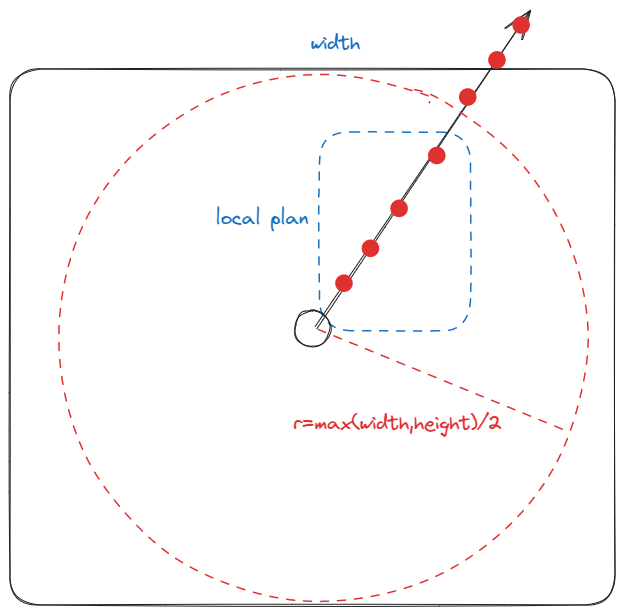
将全局路径中的部分路径点映射到局部地图中,(半个local costmap的、不能离机器人太近的)。并更新对应的打分项。映射大致示意图:
1
2
3
4
5
6
7
// costs for going away from path
path_costs_.setTargetPoses(global_plan_);

// costs for not going towards the local goal as much as possible
goal_costs_.setTargetPoses(global_plan_);

// alignment costs
然后,利用LatchedStopRotateController::isPostionReached函数判断是否已经到达目标位置,如果是,则利用LatchedStopRotateController::computeVelocityCommandsStopRotate函数计算对应的减速停止或者旋转至目标朝向的速度指令(取决于是否机器人已经停稳,进而决定实现减速停止或者旋转至目标朝向),否则利用DWAPlannerROS::dwaComputeVelocityCommands(tf::Stamped<tf::Pose> &global_pose, geometry_msgs::Twist& cmd_vel)计算DWA局部路径速度。
dwaComputeVelocityCommands
这个函数调用dwa的findBestPath:
1
base_local_planner::Trajectory path = dp_->findBestPath(global_pose, robot_vel, drive_cmds);
DWAPlanner::findBestPath
简介:给定当前机器人的状态:位姿,速度,得到一个好的轨迹。
调用SimpleTrajectoryGenerator类的函数initialise,该函数内使用了三个VelocityIterator类,来迭代xy速度和theta角。
1
2
3
4
5
6
7
8
9
10
11
12
13
for(; !x_it.isFinished(); x_it++) {
  vel_samp[0] = x_it.getVelocity();
  for(; !y_it.isFinished(); y_it++) {
 vel_samp[1] = y_it.getVelocity();
 for(; !th_it.isFinished(); th_it++) {
   vel_samp[2] = th_it.getVelocity();
   //ROS_DEBUG("Sample %f, %f, %f", vel_samp[0], vel_samp[1], vel_samp[2]);
   sample_params_.push_back(vel_samp);
 }
 th_it.reset();
  }
  y_it.reset();
}
VelocityIterator类在构造时,就会根据每个量的采样个数和最大最小值,计算出每个值,存放在vector类型的samples_中。重载了运算符++,给内部维护的变量current_index加1。
例如,x方向的速度最大最小值为0.5,0.1,采样个数为5。,则samples_数组中应为:0.1,0.2,0.3,0.4,0.5。
将这些三个维度的遍历量添加到数组sample_params_中。如果xytheta的采样个数为5,1,20,则这个数组中有5x1x20=100个。
调用SimpleScoredSamplingPlanner类的函数findBestTrajectory,传入轨迹类和轨迹类数组指针。
该类中维护了一个数组:gen_list_
1
std::vector<TrajectorySampleGenerator*> gen_list_;
存放了指向TrajectorySampleGenerator的指针。查看该类的构造函数,可以看出是在构造的时候传入的。在DWAPlanner类中,有如下调用:
1
2
3
4
5
// trajectory generators
std::vector<base_local_planner::TrajectorySampleGenerator*> generator_list;
generator_list.push_back(&generator_);
// 把轨迹生成器的指针给加进去,传给了SimpleScoredSamplingPlanner类
scored_sampling_planner_ =       base_local_planner::SimpleScoredSamplingPlanner(generator_list, critics);
可见,通过上述这种类之间传递指针的方法,使得SimpleScoredSamplingPlanner能够使用TrajectorySampleGenerator类的数据,而后者恰是上面生成的轨迹空间。
有一句:gen_success = gen_->nextTrajectory(loop_traj);根据速度空间生成轨迹。这个函数里面调用:
1
2
3
4
5
6
7
if (generateTrajectory(
        pos_,
        vel_,
        sample_params_[next_sample_index_],
        comp_traj)) {
      result = true;
    }
而函数:SimpleTrajectoryGenerator::generateTrajectory,输入机器人位姿、当前速度、速度空间的速度和轨迹指针,这个函数是生成轨迹的核心函数。怎么计算轨迹的,继续看: 计算了步长:num_steps = ceil(sim_time_ / sim_granularity_); 通过一个循环计算轨迹:
1
2
3
4
5
6
7
8
9
10
for (int i = 0; i < num_steps; ++i) {
 // 将点加入轨迹数组
 traj.addPoint(pos[0], pos[1], pos[2]);
 // 如果加速度连续,即引入加速度。根据加速度计算下一时刻的速度
 if (continued_acceleration_) {
   loop_vel = computeNewVelocities(sample_target_vel, loop_vel, limits_->getAccLimits(), dt);
  }
 // 根据速度loop_vel计算下一刻的位姿pos
 pos = computeNewPositions(pos, loop_vel, dt);
}
计算速度的公式: \(\begin{matrix} max(sample,v-a*\delta t)\\ or \\ min(sample,v+a*\delta t) \end{matrix}\) 计算位姿的公式: \(\begin{matrix} x_{i+1}=x_i+(vx*cos(\theta)+vy*cos(\pi/2+\theta))*\delta t \\ y_{i+1}=y_i+(vx*sin(\theta)+vy*sin(\pi/2+\theta))*\delta t \\ \theta_{i+1} = \theta_i + v\theta*\delta t \end{matrix}\)
轨迹计算完以后,返回到findBestTrajectory函数中,下一步计算评分:loop_traj_cost = scoreTrajectory(loop_traj, best_traj_cost);遍历每个评价器:评价器的定义在这里
1
2
3
4
5
6
7
8
std::vector<base_local_planner::TrajectoryCostFunction*> critics;
critics.push_back(&oscillation_costs_); // discards oscillating motions (assisgns cost -1) 放弃振荡运动(赋值cost -1)
critics.push_back(&obstacle_costs_); // discards trajectories that move into obstacles 丢弃移动到障碍物的轨迹
critics.push_back(&goal_front_costs_); // prefers trajectories that make the nose go towards (local) nose goal 更倾向于使机头朝向(局部)机头目标的轨迹
critics.push_back(&alignment_costs_); // prefers trajectories that keep the robot nose on nose path 更喜欢保持机器人鼻子在鼻子路径上的轨迹
critics.push_back(&path_costs_); // prefers trajectories on global path 更喜欢全球路径上的轨迹
critics.push_back(&goal_costs_); // prefers trajectories that go towards (local) goal, based on wave propagation 基于波的传播,倾向于走向(局部)目标的轨迹
critics.push_back(&twirling_costs_); // optionally prefer trajectories that don't spin 可以选择不旋转的轨迹
评价器的权重:
| 评价器 | 解释 | 权重 | rqt中的数值 | |
|---|---|---|---|---|
path_costs_ | path_distance_bias_ | 0.6 | ||
oscillation_costs_ | oscillation_reset_dist 和oscillation_reset_angle | 0.05,0.2 | ||
obstacle_costs_ | occdist_scale_ | 0.01 | ||
goal_front_costs_ | goal_distance_bias_ | 0.8 | ||
alignment_costs_ | path_distance_bias_ | 0.6 | ||
goal_costs_ | goal_distance_bias_ | 0.8 | ||
twirling_costs_ | twirling_scale | 0.0 |
然后调用每个评价器中的函数scoreTrajectory计算得分。 double cost = score_function_p->scoreTrajectory(traj); 具体怎么实现的就先不看了,每个评价器的原理大概是:
- Obstacle_costs 轨迹上是否存在障碍物以及距离障碍物的距离
- Path_costs 轨迹上点距离局部参考路径最近距离
- Goal_costs 轨迹上点距离局部参考路径终点最近距离
返回所有评价器的总和,loop_traj_cost, 遍历所有的轨迹,直到遍历完或超过指定的最大采样值max_samples_。 将最优轨迹赋给traj,findBestTrajectory函数到这里即结束了。
1
2
3
4
5
6
7
8
9
10
11
12
if (best_traj_cost >= 0) {
 traj.xv_ = best_traj.xv_;
 traj.yv_ = best_traj.yv_;
 traj.thetav_ = best_traj.thetav_;
 traj.cost_ = best_traj_cost;
 traj.resetPoints();
 double px, py, pth;
 for (unsigned int i = 0; i < best_traj.getPointsSize(); i++) {
   best_traj.getPoint(i, px, py, pth);
   traj.addPoint(px, py, pth);
 }
  }
可见,轨迹包括,xv,yv,thetav,cost,和路径点数组px,py,pth
到这里。DWAPlanner::findBestPath再将最优轨迹的xv和yv赋给期望速度,就结束了。
1
2
3
4
5
6
drive_velocities.pose.position.x = result_traj_.xv_;
drive_velocities.pose.position.y = result_traj_.yv_;
drive_velocities.pose.position.z = 0;
tf2::Quaternion q;
q.setRPY(0, 0, result_traj_.thetav_);
tf2::convert(q, drive_velocities.pose.orientation);
回到DWAPlannerROS::dwaComputeVelocityCommands函数中,判断得到的最优轨迹代价值,如果小于0,则该函数会返回false,从而引起move_base进行进一步的处理,如重新规划、recovery等。
如果大于0, 将速度赋给cmd_vel,速度指令一直回传给move_base再发布。将路径点赋给local_plan,然后发布路径。然后回到DWAPlannerROS::computeVelocityCommands函数中,再发布一次全局的 publishGlobalPlan(transformed_plan);
评价器
dwa里面使用了好几个评价器,比较重要的有三个path_costs_,goal_costs_,obstacle_costs_。前两个是base_local_planner::MapGridCostFunction类,障碍物的是base_local_planner::ObstacleCostFunction。这三个类都继承自接口类:
1
2
class MapGridCostFunction: public base_local_planner::TrajectoryCostFunction
class ObstacleCostFunction : public TrajectoryCostFunction // 这里已经定义过命名空间了
主要目的是返回一个轨迹的代价(得分)。 类中主要的成员变量:
1
2
3
4
5
6
// 接收全局路径点
std::vector<geometry_msgs::PoseStamped> target_poses_;
// 局部代价地图指针
costmap_2d::Costmap2D* costmap_;
// 栅格地图类
base_local_planner::MapGrid map_;
MapGrid类是对栅格地图进行具体操作的类,里面的成员变量是,存放了整张代价地图的栅格。注意这里的代价地图是局部的,因此数量也不会很夸张。例如局部代价地图是2mx2m,分辨率为0.05m,则尺寸为40x40=1600个栅格。
1
std::vector<MapCell> map_;
按照评价器的调用顺序来看:
- 构造:路径评价器传入代价地图指针,其余为默认值。
1
2
path_costs_(planner_util->getCostmap()),
goal_costs_(planner_util->getCostmap(), 0.0, 0.0, true),
- 在函数
updatePlanAndLocalCosts中,对评价器设置局部路径(transformed_plan)。1
path_costs_.setTargetPoses(global_plan_);
- 在dwaplanner.cpp中就没有调用了,进入
findBestTrajectory函数,在评价器的迭代器中继续调用,prepare()函数1 2 3 4
// 截取部分 std::vector<TrajectoryCostFunction*>::iterator loop_critic; TrajectoryCostFunction* loop_critic_p = *loop_critic; loop_critic_p->prepare();
对于
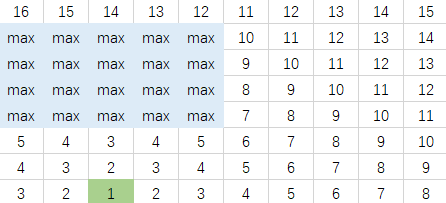
path_cost_,使用map_.setTargetCells,对于goal_costs_,使用map_.setLocalGoal。setTargetCells我看懂了,就是从第一个路径点开始,更新地图上的栅格,每个栅格中的距离信息。个人理解:绿色为第一个路径点,蓝色为障碍物,max=size^2
- 然后在
SimpleScoredSamplingPlanner::scoreTrajectory中计算得分。调用评价器的scoreTrajectory函数。1
double cost = score_function_p->scoreTrajectory(traj);
- 进入评价器的计算得分函数,aggregationType默认为Last。
计算出来最后一个点的距离信息。当根据mapgrid中的值对轨迹进行评分时,我们可以返回最后一个点的值(如果之前的点没有返回碰撞),所有点的和,或者所有(非零)点的乘积。如果跳出地图,返回-4,如果有碰撞,返回-3,如果不可达,返回-2。
ObstacleCostFunction
06-20 16:45: dwa ObstacleCostFunction:
1
2
3
4
5
6
7
8
9
10
11
12
13
14
15
for (unsigned int i = 0; i < traj.getPointsSize(); ++i) {
    traj.getPoint(i, px, py, pth);
    double f_cost = footprintCost(px, py, pth,
        scale, footprint_spec_,
        costmap_, world_model_);

    if(f_cost < 0){
        return f_cost;
    }

    if(sum_scores_)
        cost +=  f_cost;
    else
        cost = std::max(cost, f_cost);
}
对路径上的每一个计算一次footprintCost,这个函数输入当前的位姿、比例因子、机器人轮廓、costmap模型。在进去就是带有比例因子的点:
1
double footprint_cost = world_model->footprintCost(x, y, th, scaled_footprint);
需要注意这里是基类指针,实际调用的是CostmapModel对象:
1
2
3
4
5
6
7
8
9
10
11
12
13
14
15
16
17
18
19
20
21
22
23
24
25
26
27
28
29
30
double
CostmapModel::footprintCost(const geometry_msgs::Point &position,
                            const std::vector<geometry_msgs::Point> &footprint,
                            double inscribed_radius,
                            double circumscribed_radius) {
    // returns:
    //  -1 if footprint covers at least a lethal obstacle cell, or
    //  -2 if footprint covers at least a no-information cell, or
    //  -3 if footprint is [partially] outside of the map, or
    //  a positive value for traversable space
...
    // we need to rasterize each line in the footprint
    for (unsigned int i = 0; i < footprint.size() - 1; ++i) {
        // get the cell coord of the first point
        if (!costmap_.worldToMap(footprint[i].x, footprint[i].y, x0, y0))
            return -3.0;

        // get the cell coord of the second point
        if (!costmap_.worldToMap(footprint[i + 1].x, footprint[i + 1].y, x1,
                                 y1))
            return -3.0;

        line_cost = lineCost(x0, x1, y0, y1);
        footprint_cost = std::max(line_cost, footprint_cost);

        // if there is an obstacle that hits the line... we know that we can
        // return false right away
        if (line_cost < 0)
            return line_cost;
    }
先判断每个点是否在地图上。再进入一个循环,两两之间进行连线。这里使用了一个直线迭代器LineIterator,输入直线两个端点的坐标(int),遍历这个直线上的所有点,遍历方法封装的比较好:
1
for (LineIterator line(x0, y0, x1, y1); line.isValid(); line.advance())
advance这个方法里面每次运行会使x和y按照直线方向加1。算法这里不关心,主要看ROS的costmap层面。
1
2
3
4
5
6
7
8
9
10
double CostmapModel::pointCost(int x, int y) const {
    unsigned char cost = costmap_.getCost(x, y);
    // if the cell is in an obstacle the path is invalid
    if (cost == NO_INFORMATION)
        return -2;
    if (cost == LETHAL_OBSTACLE)
        return -1;

    return cost;
}
对直线上的每个点都计算一次,如果是未知则返回-2,致命障碍物则返回-1。所以也就完成了注释中强调的:
1
2
3
4
5
// returns:
//  -1 if footprint covers at least a lethal obstacle cell, or
//  -2 if footprint covers at least a no-information cell, or
//  -3 if footprint is [partially] outside of the map, or
//  a positive value for traversable space
a是所有连线里面costmap最大的值。 所有double ObstacleCostFunction::scoreTrajectory这个函数,返回和上面一样,如果不是负的,返回的是最大值。